Design thinking is a potent tool for solving problems with ingenuity. While various models exist, each brings unique attributes to the table.
Let’s delve into how Stanford’s d.school model stands against other prominent frameworks.
Stanford’s d.school Model
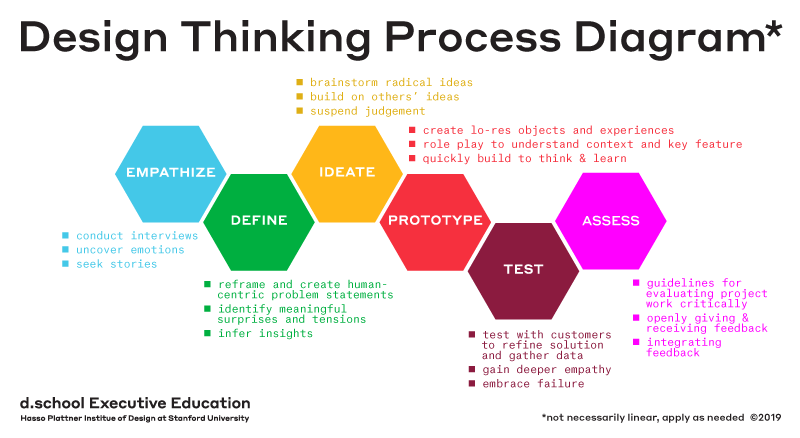
Stanford’s d.school design thinking model encompasses five pivotal stages:
- Empathize: Delve into understanding the end-users.
- Define: Articulate the core problem succinctly.
- Ideate: Engage in brainstorming a plethora of ideas.
- Prototype: Construct basic, functional models.
- Test: Validate solutions through user interaction.
This approach prioritizes empathy and rapid prototyping, ensuring a user-centered design process.
IDEO’s Design Thinking Model
IDEO helped popularize Design Thinking as a human-centered approach to innovation.
Rather than treating Design Thinking as a rigid sequence of steps, IDEO describes it as a flexible and iterative process. At its core, the approach brings together three important perspectives:
- Desirability: What do people actually need and want?
- Feasibility: What is technically possible?
- Viability: What can work as a sustainable solution for the organization?
IDEO’s current Design Thinking framework expands this thinking into a flexible set of components that teams can move between as they research, create, prototype and learn.
The important principle is similar to the Stanford model: teams learn by understanding people, making ideas tangible and improving them through experimentation.
IBM’s Design Thinking Model
This model, known as the Loop, emphasizes ongoing collaboration:
- Observe: Gather insights through observation and listening.
- Reflect: Synthesize findings and conceptualize ideas.
- Make: Build and test prototypes iteratively.
IBM’s approach underscores the importance of teamwork and continuous feedback, promoting a collaborative design ethos.
The Double Diamond
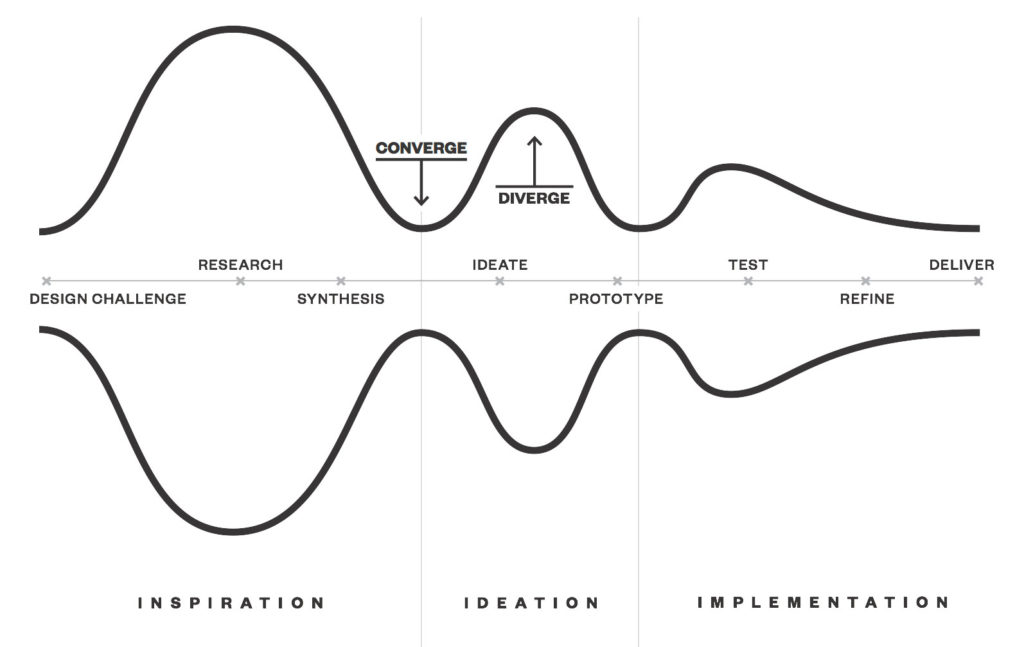
The Double Diamond was developed by the UK Design Council and visualizes the design process through four phases:
Discover → Define → Develop → Deliver
What makes the model particularly useful is its clear distinction between divergent and convergent thinking.
During Discover, teams explore the problem broadly and gather insights. During Define, they narrow those insights into a clear challenge.
The process then expands again during Develop as multiple possible solutions are explored, before converging during Deliver as ideas are tested, refined and prepared for implementation.
Compared with Stanford’s five modes, the Double Diamond places more visual emphasis on alternating between exploring possibilities and making decisions.
Which Design Thinking Model Should You Use?
There is no single Design Thinking model that is best for every situation.
Choose Stanford d.school if you want an easy-to-understand framework for learning and applying human-centered design.
Choose IDEO when innovation needs to balance what people want with what is technically feasible and viable for the organization.
Choose IBM Enterprise Design Thinking when Design Thinking needs to work across larger teams and organizations where continuous alignment is important.
Choose the Double Diamond when you want a particularly clear structure for moving between exploring a problem, defining it, developing alternatives and converging on a solution.
In practice, experienced teams often borrow tools and principles from several frameworks rather than following one model mechanically.
| Model | Process | Strongest for | Main characteristic |
|---|---|---|---|
| Stanford d.school | Empathize → Define → Ideate → Prototype → Test | Learning Design Thinking, user-centered innovation | Strong emphasis on empathy and experimentation |
| IDEO | Flexible, iterative human-centered process | Innovation and product/service development | Desirability, feasibility and viability |
| IBM Enterprise Design Thinking | Observe → Reflect → Make | Large organizations and multidisciplinary teams | Continuous Loop plus alignment practices |
| Double Diamond | Discover → Define → Develop → Deliver | Structuring complex problems | Clear divergence and convergence |
Comparative Insights
- Stanford champions empathy and swift prototyping to deeply understand user needs.
- IDEO focuses on iterative refinement and learning, allowing for flexible adaptation.
- IBM promotes a collaborative cycle of observing, reflecting, and making, fostering a team-centric innovation culture.
Practical Example
Consider a scenario where you’re designing a new mobile app.
With Stanford’s model, you would begin by immersing yourself in the user experience.
IDEO’s framework would then have you iterating based on user feedback.
Meanwhile, IBM’s approach would involve close teamwork and regular feedback loops to refine the app continuously.
Real-Life Applications
Stanford’s Model in Action
At Stanford, students use this model to tackle real-world problems. For instance, they might work on projects to improve healthcare delivery in underserved areas.
They begin by empathizing with patients and healthcare providers, defining specific challenges, brainstorming potential solutions, building prototypes like new patient intake systems, and testing these solutions in actual clinics.
This hands-on, user-centered approach ensures the solutions are practical and effective.
IDEO’s Model in Practice
IDEO has used its model to innovate across various industries. One notable example is their work with a major airline to redesign the boarding process.
They started with in-depth research, observing and interviewing passengers and staff. From there, they identified key pain points, such as long wait times and confusion.
Through iterative ideation and prototyping, they developed new boarding procedures and tools, continuously refining them based on user feedback. The result was a smoother, more efficient boarding experience.
IBM’s Loop in Use
IBM employs the Loop model in its internal projects and client work. For example, when developing a new enterprise software solution, they start by observing how employees interact with existing tools.
They then reflect on this data, generating insights and ideas for improvement. Prototyping and testing happen in short, iterative cycles, allowing them to refine the software quickly. This collaborative, feedback-driven process ensures the final product meets user needs and business goals.
Conclusion
Each design thinking model offers distinct advantages. For profound user insights and rapid prototyping, Stanford’s d.school model excels. IDEO’s model is ideal for iterative development and adaptability.
IBM’s Loop model is perfect for fostering collaboration and ongoing improvement. Choose the model that best aligns with your organizational needs and project goals.
References:
- Stanford d.school: Stanford d.school Design Thinking
- IDEO: IDEO Design Thinking
- IBM: IBM Design Thinking